01 / Context
Overview
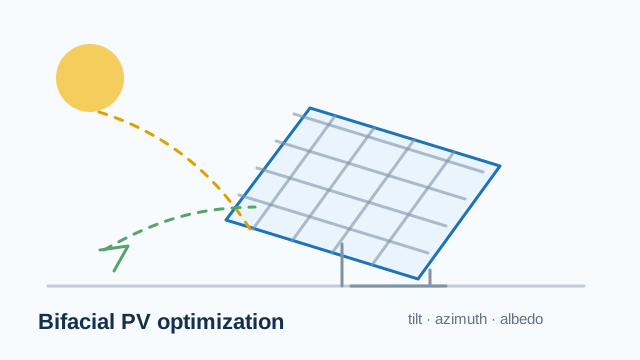
A physics-informed optimization model was developed to determine bifacial PV tilt and azimuth by maximizing incident solar radiation on the front and rear surfaces. The formulation accounts for direct irradiation, angle-of-incidence effects, reflection losses, rear-side geometry, and practical bounds on the orientation variables.
Three years of NREL data sampled at 15-minute resolution were used. The resulting orientation was then compared against reference and PVSyst cases using annual energy production together with economic indicators such as LCOE, payback period, NPV, IRR, and ROI.
My work
- Formulated the bifacial-PV objective function and practical orientation constraints.
- Implemented COBYLA optimization using historical meteorological data.
- Compared the optimized orientation with PVSyst and literature/reference tilt values.
02 / Approach
Methods & diagrams
Irradiance Model
Front/rear direct and diffuse irradiance are computed from meteorological measurements, solar geometry, and angle-dependent reflection behavior.
Constrained Optimization
COBYLA searches the admissible tilt/azimuth space while enforcing orientation and angle-factor constraints.
PVsyst Comparison
Energy-yield and economic metrics are compared for the optimized, PVSyst, and reference orientations.
Findings
- The documented case produced an optimized tilt of 24.6°.
- In the report scenario, that case produced higher annual energy and improved economic metrics than the two comparison cases.
- The framework is flexible enough to change objectives, datasets, and seasonal constraints.
Scope & limitations
The reported optimum and economic comparisons apply to the case and assumptions in the report, not to all sites or bifacial installations.