01 / Context
Overview
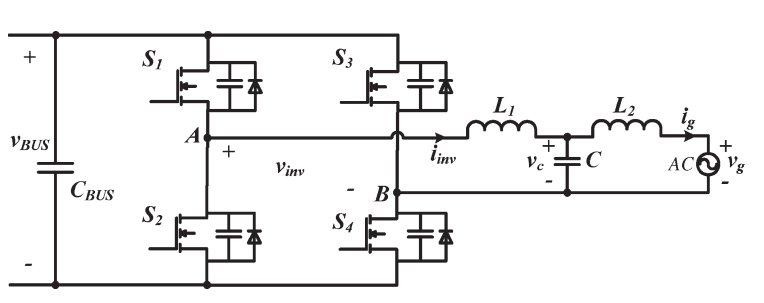
This control-systems project models an LCL-filtered grid-connected voltage-source inverter in state-space form. The control objective is to make the inverter current track the grid-current reference while damping the resonance naturally introduced by the LCL filter.
After deriving the plant equations, controllability and observability were checked, feedback poles were selected, and a full-state feedback gain was obtained using pole placement. A state observer was then added so the controller could operate using estimated rather than directly measured internal states.
My work
- Derived the inverter/LCL-filter state-space model from the circuit equations.
- Verified stability, controllability, and observability numerically in MATLAB.
- Designed pole-placement state feedback and an observer and implemented both in Simulink.
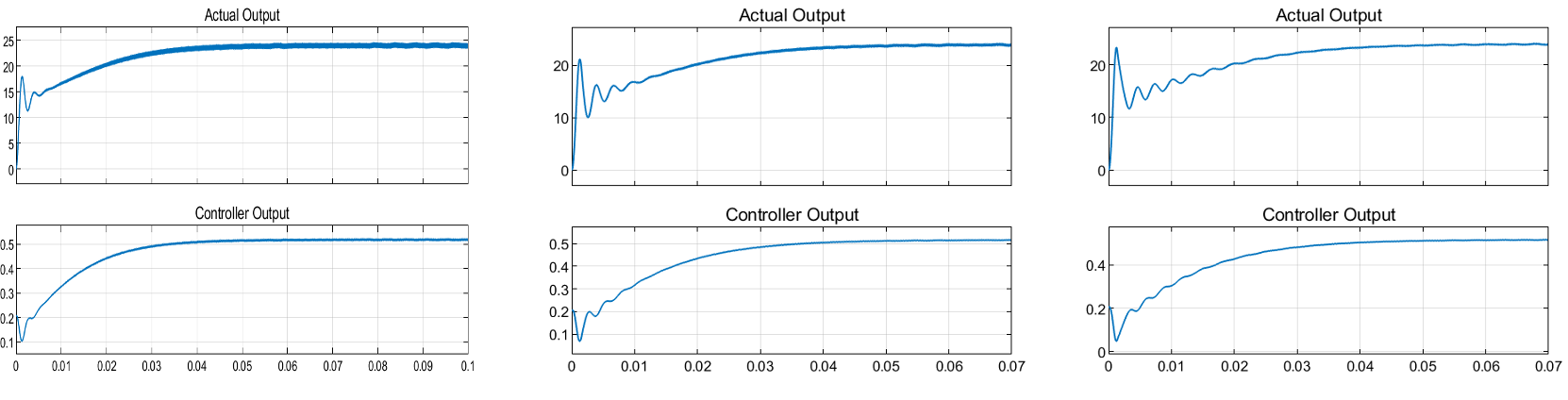
- Compared open-loop resonance with closed-loop current tracking and examined observer initial-condition effects.
02 / Approach
Methods & diagrams
Full-State Feedback
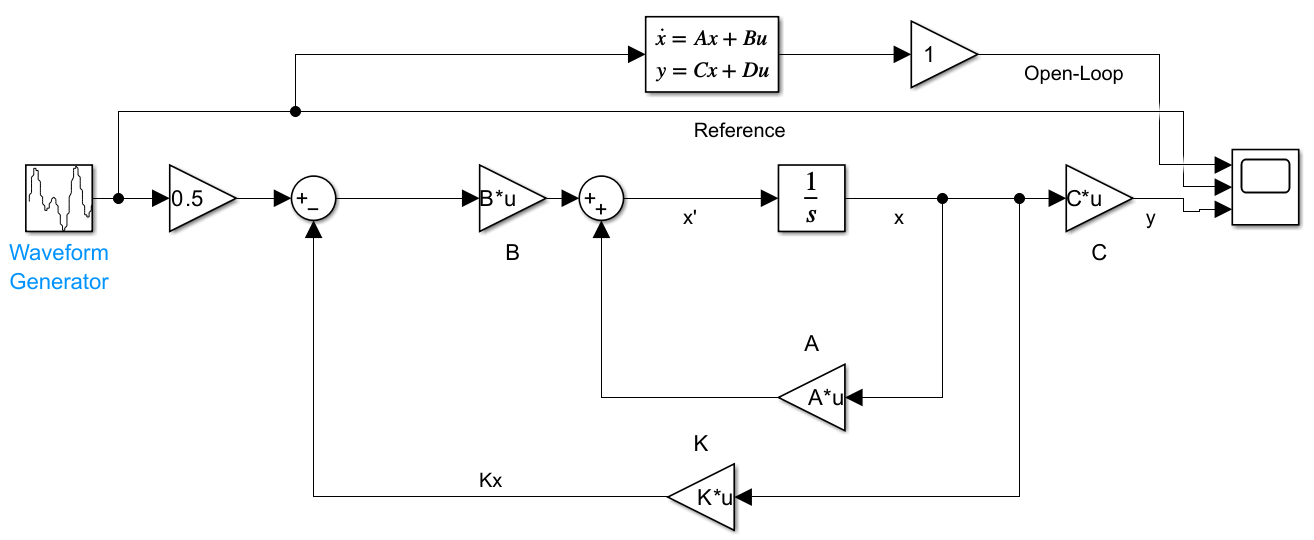
The controller uses pole placement to modify the LCL-filtered plant dynamics, damp resonance, and improve tracking of the AC current reference.
State Observer
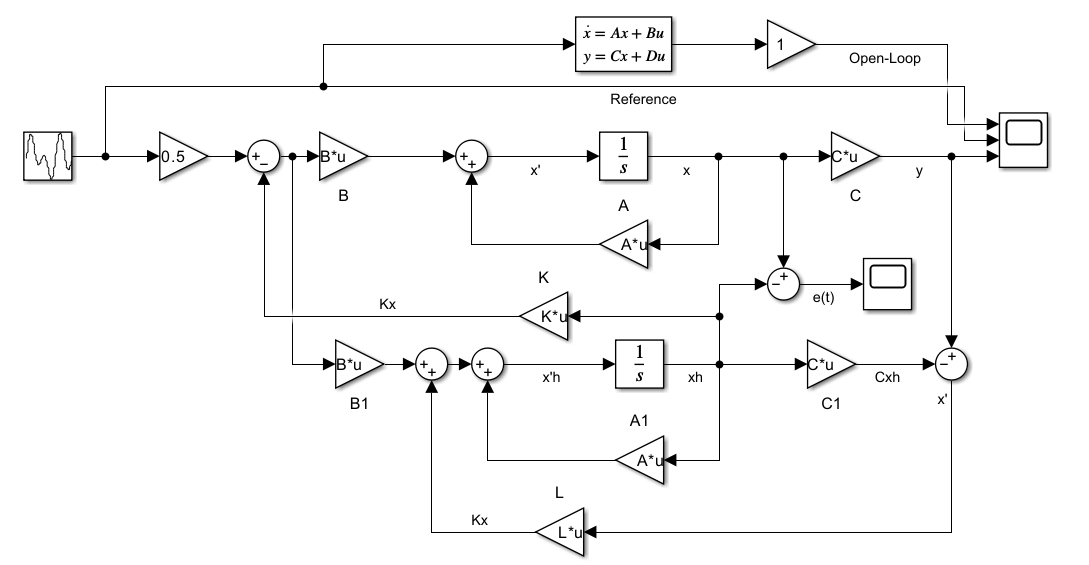
A Luenberger-style observer estimates internal states for the feedback law when all state variables are not directly available.
Simulation Validation
Open-loop, feedback, and observer-based responses are compared in MATLAB/Simulink, including the effect of nonzero observer initial-condition error.
Findings
- The open-loop model exhibits strong LCL resonance, while the designed feedback substantially improves reference tracking.
- Observer initial-condition errors can increase settling time even when the nominal closed-loop design is stable.
- The project provided an early link between classical state-space control and grid-connected power-electronic converters.
Scope & limitations
The analysis uses the simplified plant and assumptions of the Linear Systems coursework. It is a simulation study, not a physical grid-connection test.